
Read Harvey County Deed Records
A deed does several jobs at once. It names the parties, states the interest conveyed, and describes the land, then earns a recording stamp once the office accepts it. Read the whole instrument. Work through the granting clause, the execution and acknowledgment, the legal description, any prior reference, and attached validation material.
| Deed Type | What It Does | Common Use |
|---|---|---|
| Warranty deed | Conveys an interest with stated warranties | Ordinary sale or transfer |
| Special warranty deed | Provides warranties limited by its terms | Narrower transfer assurances |
| Quitclaim deed | Conveys whatever interest the grantor holds | Family transfer or title cleanup |
| Trustee or executor deed | Conveys through an authorized fiduciary | Trust or estate transfer |
| Sheriff's or tax deed | Follows a court or tax-sale process | Distressed-property transfer |
A mortgage or lien is not another deed. It records a claim or encumbrance against the land. Trace its release, assignment, satisfaction, or court outcome separately. A name-only match stays weak unless the legal description matches too.
Harvey County Deeds Office Access
The Harvey County Register of Deeds, led by Raquel Langley, sits at 800 N Main Street, PO Box 687, Newton, Kansas 67114. Call 316-284-6950 or email rlangley@harveycounty.gov. The office welcomes public research. It asks visitors to schedule an appointment first. Harvey County publishes no online grantor-grantee search form or deed-image viewer. Before calling, gather an owner name, parcel ID, legal description, rough date, and any known recording reference. Bring a known recording reference if you have one. That detail helps staff tell a single copy request from an open-ended chain search. Review the official deeds office page for the office's own description. It also lists its services and document types.
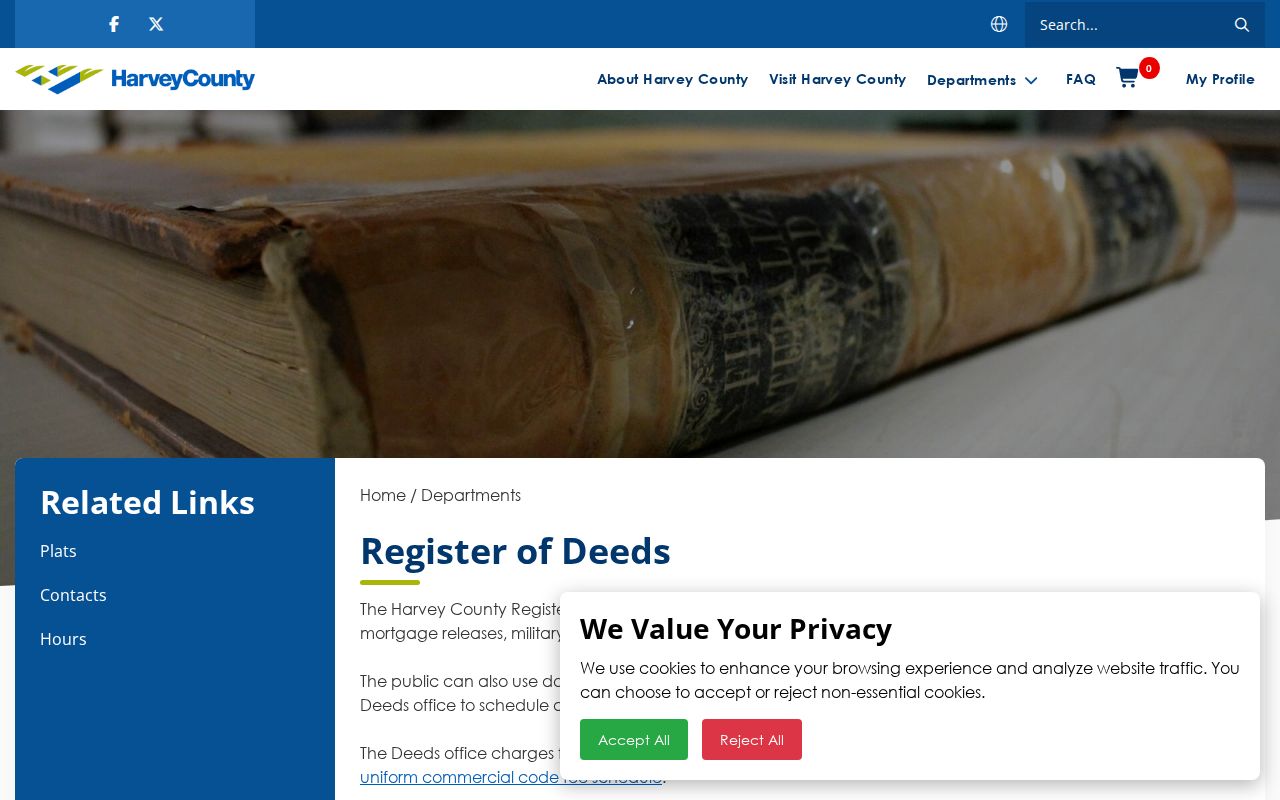
The official page lays out the office route and the document types it records. It offers no live index fields or online coverage.
Harvey County Instrument Fields
The office can confirm the exact index entry for any instrument. Historical finding aids suggest what facts to capture. They say nothing about a current county system's design.
| Record element | Why it matters | Verified route |
|---|---|---|
| Grantor and grantee | Links the party giving and receiving an interest | Office request or historical index |
| Instrument type | Separates deed, mortgage, release, lien, and plat | County office inventory |
| Filing date | Places the record in sequence | Office entry or microfilm |
| Property description | Matches the document to the land | Deed, plat, and city-lot index |
| Book/page or instrument number | Retrieves the recorded image | Office or archival image |
Walk Harvey County's Deed Chain
A chain of title is the ordered run of instruments linking one transfer to the next. Begin with the most recent confirmed owner. Then work backward. A shared surname or address never guarantees the same parcel.
- Get the parcel ID and exact legal description from GIS, tax, or appraisal sources.
- Identify the current owner's purchase deed by searching that owner as grantee through the office route.
- Read the grantor, prior reference, legal description, date, and type from the deed.
- Search that grantor as an earlier grantee, then repeat while matching the land.
- Check mortgages, releases, liens, plats, and court notices around each transfer.
- Grantor
- The party giving the stated interest.
- Grantee
- The party receiving that interest.
- Chain of title
- The linked sequence of transfers for the same land.
- Book/page
- A volume and page reference used to retrieve a record.
- Instrument number
- A unique filing reference assigned to a document.
City-Lot Deeds on Microfilm
The Kansas State Historical Society city-lot index offers the strongest official path for an older urban chain. It spans 1871 through 2001 on microfilm MF5446 through MF5453. Entries may show grantor, grantee, instrument, filing date, and property description. Reels are arranged by towns, volumes, blocks, and additions. Newton spans MF5446 through MF5449. Sedgwick appears on MF5450. Halstead and Burrton occupy MF5451 and MF5452. Hesston shares MF5453 with other named areas. Translate a modern address to block and lot through a plat before choosing a reel. Open the KSHS finding aid to view the collection.
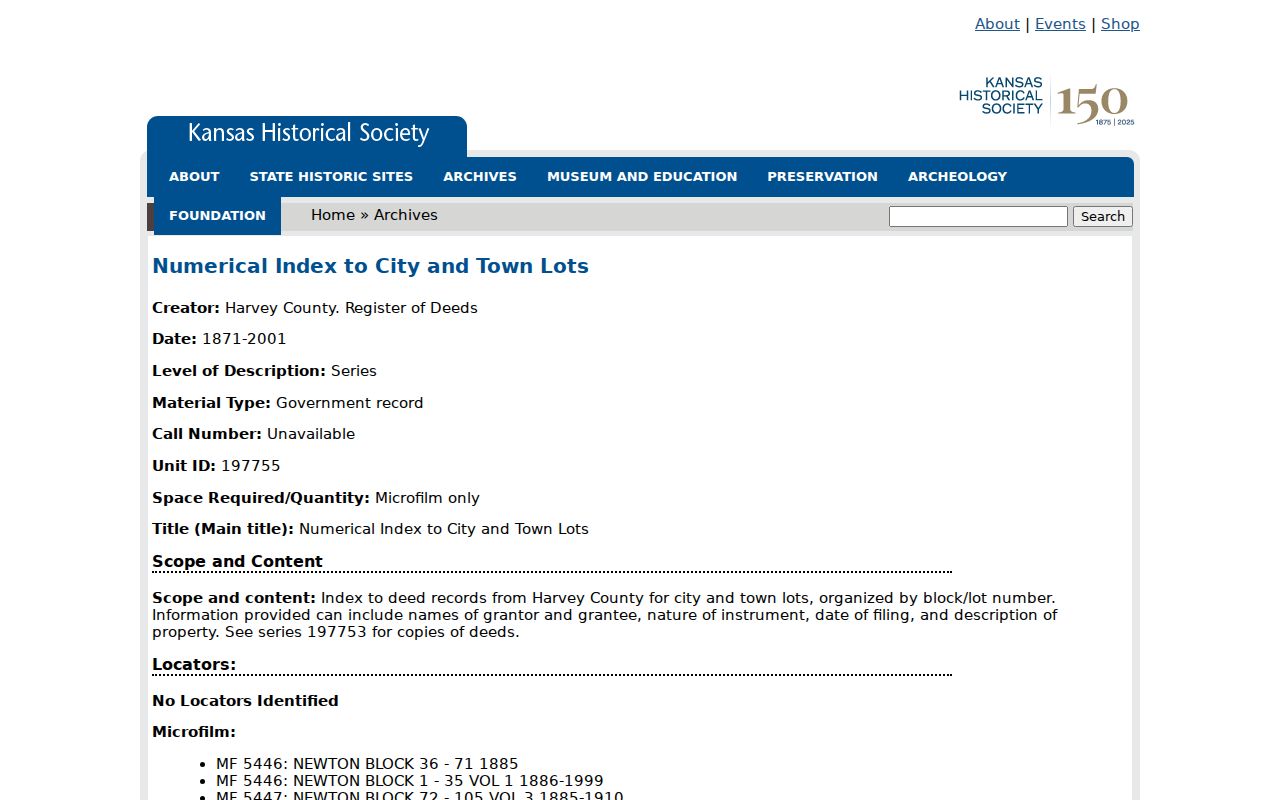
The finding aid points to microfilm rather than digitized deed pages.
Harvey County's Older Deed Books
KSHS catalogs Harvey County deed records from 1862 through 1927. Those dates overlap county formation in 1872 and Newton's first plat in 1871. So early entries deserve place-name and jurisdiction checks. This archive series says nothing about any current online start year. For every source, record the repository and the reel or book. Note the page and your viewing date too. Say whether you used an index or instrument images. An index points to a deed. It never replaces reading the deed itself.
Access limit. Harvey County publishes no verified public online grantor-grantee cutoff in the sources located; older city-lot work relies on office research and KSHS microfilm.
Liens Beside Harvey County Deeds
The Register of Deeds records mortgages and mortgage releases. It also records federal and state tax liens and other public instruments. Search each transfer period for the original filing and its later release or assignment. A missing release calls for follow-up. It does not prove a debt remains. A lis pendens gives notice of litigation affecting real estate. Read the district court case for the outcome. UCC fixture questions may require the Kansas Secretary of State system. Keep the debts separate. A paid property-tax result cannot release a mortgage. A mortgage release does not resolve an unrelated tax debt.
Plats Join Harvey County Deeds
A plat sets out lots, blocks, streets, and easements. Under Harvey County's procedure, an approved final plat goes to the Register of Deeds. Recording must happen within one year. Otherwise approval may be withdrawn. Construction or a building permit cannot begin before final recording. The plat comes first in practice as well as law. Replats may split lots or correct monuments or bearings. They can also alter easements, remove lot lines, vacate land, or rename features. Keep unusual lot labels such as 1A or 4A and 4B exactly as recorded. A plat aids the deed search but never replaces a survey.
Check Harvey County Filing Costs
The county fee schedule is dated 2019 and says it took effect in 2014. It lists $21 for the first page of deeds, mortgages, and other instruments, with $17 for each added page. Mortgage assignments or releases run $20 plus $4. Town plats cost $32 per page, and certifying a record adds $13. Treat these as historical references, not current quotes. Call 316-284-6950 before filing or ordering. Ask for current copy, certification, recording, postage, and appointment terms. The schedule states fees are due before filing. It also warns that illegible instruments may be rejected. Note: A dated fee PDF can guide the question, but only the deeds office can confirm today's amount and payment method.
Request a Harvey County Deed Copy
Contact the Register of Deeds by phone or email. Say upfront whether a plain copy or a certified copy is what you need. Then supply the details that let staff pull the deed fast. These include the grantor, grantee, parcel number, legal description, document type, an approximate filing date, and any book and page or instrument number you already hold. Before ending the conversation, ask how payment is accepted. Also ask whether the copy gets mailed or handed over at an appointment.
Recorded, not guaranteed. Harvey County deed records show accepted instruments, not a title opinion. Unrecorded interests or unresolved defects may still exist.
Preserve Harvey County Deed Citations
A good deed citation captures more than a surname. Record the instrument type, execution date, filing date, grantor, grantee, book and page or instrument number, and the full legal description. Copy any prior-recording reference exactly as printed. Those fields let another researcher pull the same Harvey County deed. They also tell it apart from an instrument involving someone with the same name.
When the office index points to microfilm, note the reel. Add the volume, page, town, block, and lot. The KSHS city-lot finding aid is an access key, not the deed itself. Pull the image or office copy before treating an indexed name as a completed transfer. If handwriting or an abbreviation is unclear, mark it uncertain. Then compare the tax roll, plat, or a second index rather than silently correcting it.
Deed research also benefits from a chronology. Keep mortgages, assignments, releases, liens, lis pendens notices, plats, and correction instruments in date order. Arrange them around each conveyance. They can explain the state of the record without necessarily changing ownership. A release must be matched to the instrument it satisfies. A court notice needs the related case outcome.
When ordering, confirm whether the copy is plain or certified and check the current charge. A certified copy carries the custodian's authentication. An index printout or finding-aid image does not become the recorded instrument just because it names the parties. Keep the receipt and citation together with the copy.