
Compare Harvey County Property Value Types
A single parcel can carry several valid figures, since each one serves a different record function. Name the figure before comparing anything.
| Value type | What it means | Where it is recorded |
|---|---|---|
| Market value for assessment | The Appraiser's value basis under Kansas appraisal rules | County assessment record |
| Assessed value | The classification percentage applied to market value | Assessment and tax records |
| Last sale or consideration | A transaction fact from a transfer | Deed-related or registered sale access |
A recorded sale reflects its own date and terms. Assessed value exists to support taxation, so the two numbers answer different questions and neither stands in for a current independent appraisal.
Calculate Harvey County Residential Assessment
Kansas Constitution Article 11 sets the classification percentages that drive assessed value. Residential real property, including apartments, is assessed at 11.5 percent of fair market value. Vacant lots are assessed at 12 percent. Commercial and industrial real property carries 25 percent. Agricultural land is valued on income or productivity and assessed at 30 percent. Other classes have their own rates.
For a residential illustration only, multiply a $200,000 market value by 11.5 percent. That gives $23,000 in assessed value. The arithmetic explains how the figures relate. It says nothing about the property's tax bill or its sale price.
Value limit. Harvey County assessed value is a tax calculation component. It is not an appraisal and does not state what the property would sell for.
Look Up Harvey County Assessed Value
The Harvey County Appraiser CIC portal offers both public and registered entry. The public result card does not reliably display land, improvement, total, exemption, and history labels, so request the full detail directly from the Appraiser.
- Continue through public access and identify the parcel by the supported options actually shown.
- Confirm the situs, parcel key, legal description, class, and tax year.
- Record each value label exactly instead of merging land, improvements, total, and assessed figures.
- Save the database timestamp and ask the Appraiser for fields the card does not expose.
The Appraiser can also provide additional cost information on request. Never invent a cost breakdown the card does not show.
The Harvey County Portal Has Two Access Levels
Harvey County makes sale information available to registered users under K.S.A. 79-1437f. A missing public sale figure therefore does not prove that no transfer occurred. Check the recorded deed, or use the proper registered or office channel for sale data. The official Harvey County Real Estate page documents that access split. It also routes value questions to the Appraiser.
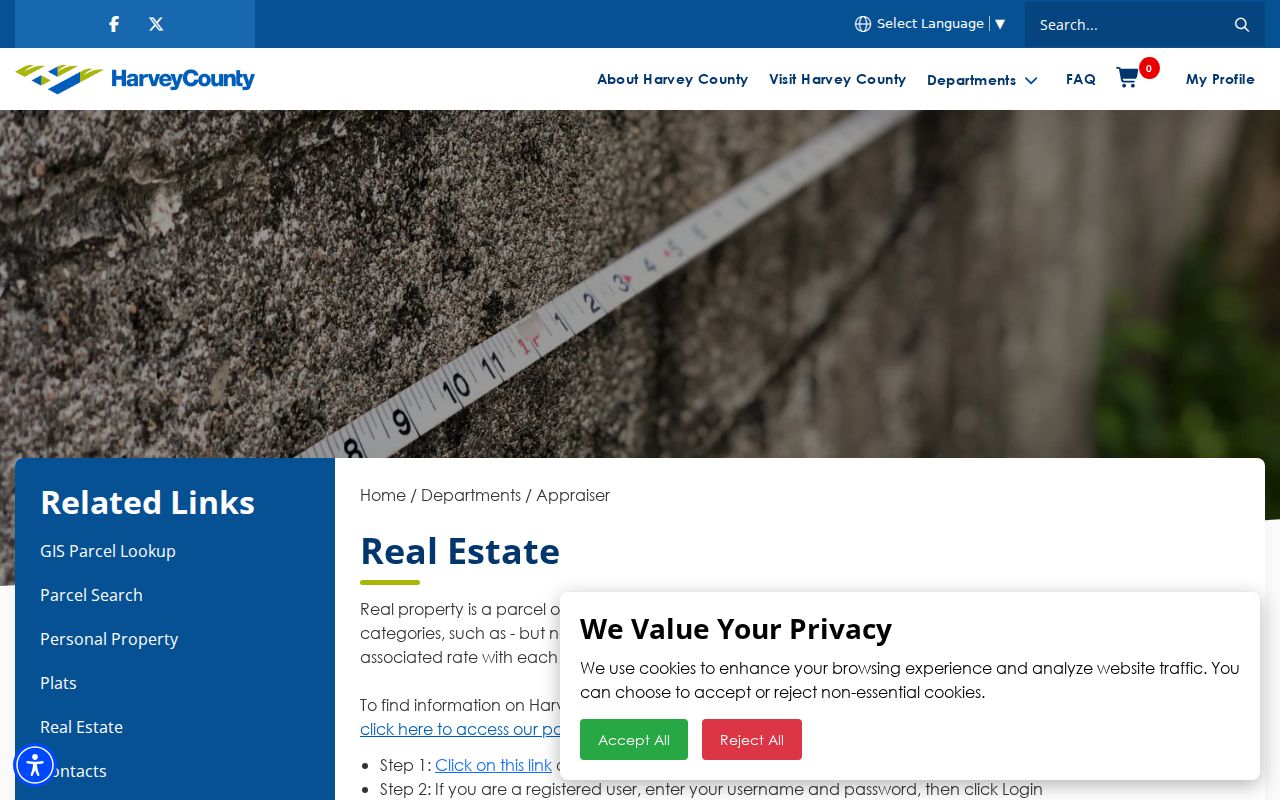
Start with the county's own real estate page whenever a public value card or sale detail is unavailable. It points to the right office and the right access level.
Date Every Harvey County Value Record
The CIC landing page displays a database update timestamp, most recently September 8, 2026 at 2:03 a.m. That timestamp measures the portal database. It is not the effective date of every appraisal or deed, so pair it with the tax year and any instrument date before drawing conclusions.
Value history also needs consistent categories. A market-value series should not be compared directly against assessed-value figures unless the classification percentage and year are identified.
Note: Save the portal timestamp, tax year, property class, and label beside every copied Harvey County value.
Recorded Sale Price Is a Separate Harvey County Fact
A deed documents a transfer. It may include consideration. It can also tie into the Kansas real-estate sales validation process. The Register of Deeds handles recording. Sale information inside the CIC system sits behind the county's registered-user rule. These two routes serve different purposes.
A sale can also be stale or non-arm's-length. It may be part of an estate. Or it may be shaped by terms a single figure never shows. Treat any recorded amount as one dated transaction. Do not treat it as an estimate of current property value.
Classes Change Harvey County Value Comparisons
Applying the residential 11.5 percent rate to every parcel would be a mistake. Commercial and industrial real property, vacant lots, agricultural land, and other classes each follow different Kansas treatments. Verify the class first, especially on mixed-use land.
- Market value
- The Appraiser's value basis for the assessment process.
- Assessed value
- The class percentage applied to that basis.
- Assessment ratio
- The Kansas percentage assigned to the property class.
- Sale consideration
- A separate transfer fact tied to a dated transaction.
- Reassessment
- A new valuation cycle or update, not a guaranteed sale forecast.
Know What Harvey County Property Value Omits
A roll figure does not disclose every repair, private inspection, financing term, easement effect, title issue, or buyer preference. It does not settle the exact boundary either. Treat it as a dated public assessment fact and nothing more.
Questions about the tax bill, exemptions, or appeals belong with the Harvey County property tax records guide. This page stops at what the value figures mean and where they live.
Ask the Harvey County Appraiser for Missing Detail
The Appraiser sits at 215 S Pine Street in Newton. The office answers the phone at 316-284-6820. A focused request should include the parcel key and legal description. It should also include the tax year and the exact value field needed. Under KORA, ask for an existing record rather than a custom estimate.
When comparing properties, hold the same year, class, and value type across every row. That keeps assessed values from mixing with market values or transaction amounts. It also gives the comparison a reproducible basis.
Separate Land and Improvements in Harvey County
A parcel record may distinguish land, improvements, and total value. The public CIC card does not consistently show those exact labels, though. Ask the Appraiser for the existing detail rather than assuming a screen field. Land value concerns the site component. Improvement value covers taxable structures and additions as the appraisal system classifies them.
A change in one component does not reveal its cause. New construction, demolition, a classification shift, a review, or a data correction can all affect the record. Check permits and the appraisal year before calling any difference market appreciation.
Use the Harvey County Tax Module as a Cross-Check
The Treasurer module covers a lot of ground. Search fields include tax type, segmented CAMA key, and owner or taxpayer. You can also pick year, tax ID, and delinquent or current status. It also drills down by street, subdivision, block, and lot. Section-township-range, lease, Quick Ref, and name work too. It ties a value question to the right tax year and parcel cleanly. Just remember that the tax bill is not the same thing as assessed value. The Harvey County tax search runs on its own system. That keeps it separate from the CIC real-estate entry.
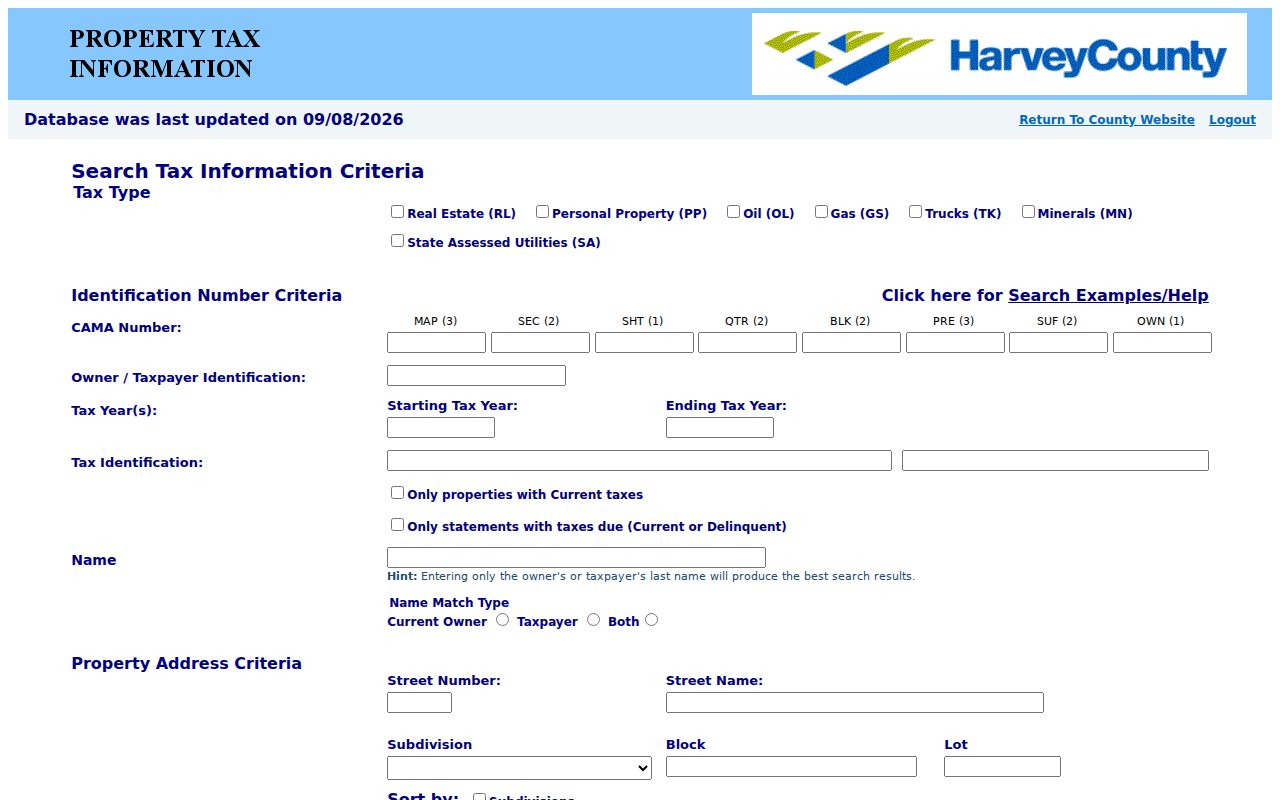
The official search form itself makes the point: copy a value only alongside the parcel key and the tax year it came from. Payment details and appeal questions belong in the tax-record guide, not here.
Compare Harvey County Values Without Mixing Years
Keep the comparison honest. Use the same value label, the same property class, and the same tax year across every figure. Market value compares to market value. Assessed value compares to assessed value. Mixing classes invites trouble, because Kansas classification percentages can push assessed totals apart even when market values sit close together.
For a sale comparison, record the instrument date first. Then ask whether the deal was an ordinary open-market sale. Never blend assessment values and sale prices into one unofficial estimate. Each number keeps its own source and role.
Explain Changes in Harvey County Property Value
A jump from one year to the next can have several causes. A new appraisal, a physical change, a classification correction, a parcel split, or simply updated data could all be behind it. The roll figure alone never explains itself. Compare the same fields across both years. Check the legal description and parcel key. Then ask the Appraiser for the record supporting the change. County staff maintain values and handle taxpayer appeals under Kansas rules. But read the value record before drawing any conclusion.
Exemptions complicate the picture. They change taxable treatment without touching market value. Homestead and SAFESR questions route through the County Clerk. And eligibility should never be guessed from a name or mailing address. Keep four facts separate: gross value, assessed figure, exemption treatment, and final tax amount.
Splits and replats hide in plain sight. If a parcel was split, replatted, or consolidated, an apparent jump may be comparing different land entirely. Pull up GIS and recorded plats to confirm the footprint for each year. That way a value-history chart will not treat a reshaped parcel as identical across the whole period.