
Trace Harvey County Former Owners by Transfer
A backward timeline keeps each former owner tied to an actual recorded deed. Harvey County offers no public online grantor-grantee index for deed records. The Register of Deeds welcomes public research. The office asks visitors to call ahead for an appointment. Work through the recorder first. Then turn to archival sources.
| Transfer period | Grantor to grantee | Record key | Route |
|---|---|---|---|
| Newest transfer | Prior owner to current grantee | Date and legal description | Register of Deeds |
| Earlier transfer | Earlier grantor to prior grantee | Book/page or instrument | Office index and volumes |
| 1871 to 2001 city lots | Indexed grantor and grantee | Town, block, lot, volume | KSHS microfilm |
| Historic tax years | Taxpayer for a given year | Land description | KSHS rolls |
Treat this as a framework rather than a finished chain. Add a name only after a real instrument and land description tie that person to the parcel.
Harvey County Publishes No Online Cutoff
The county publishes no stated starting date for its live deed index. It offers no public image viewer for deed records. Call 316-284-6950 with a party name, rough date, and legal description. Bring any record key you hold. The office sits at 800 N Main Street in Newton. That in-person route remains the documented path for the recorder's holdings.
Coverage limit. Harvey County publishes no verified online start year. Older owners require office indexes, deed books, or archive microfilm.
A KORA request can ask for an existing deed or index entry. The office does not have to build a custom chain of title for you.
City-Lot Film Extends Harvey County Former Owners
The KSHS Harvey County city-lot index covers 1871 through 2001. It lists grantor, grantee, deed type, filing date, book and page, town, block, and lot ranges.
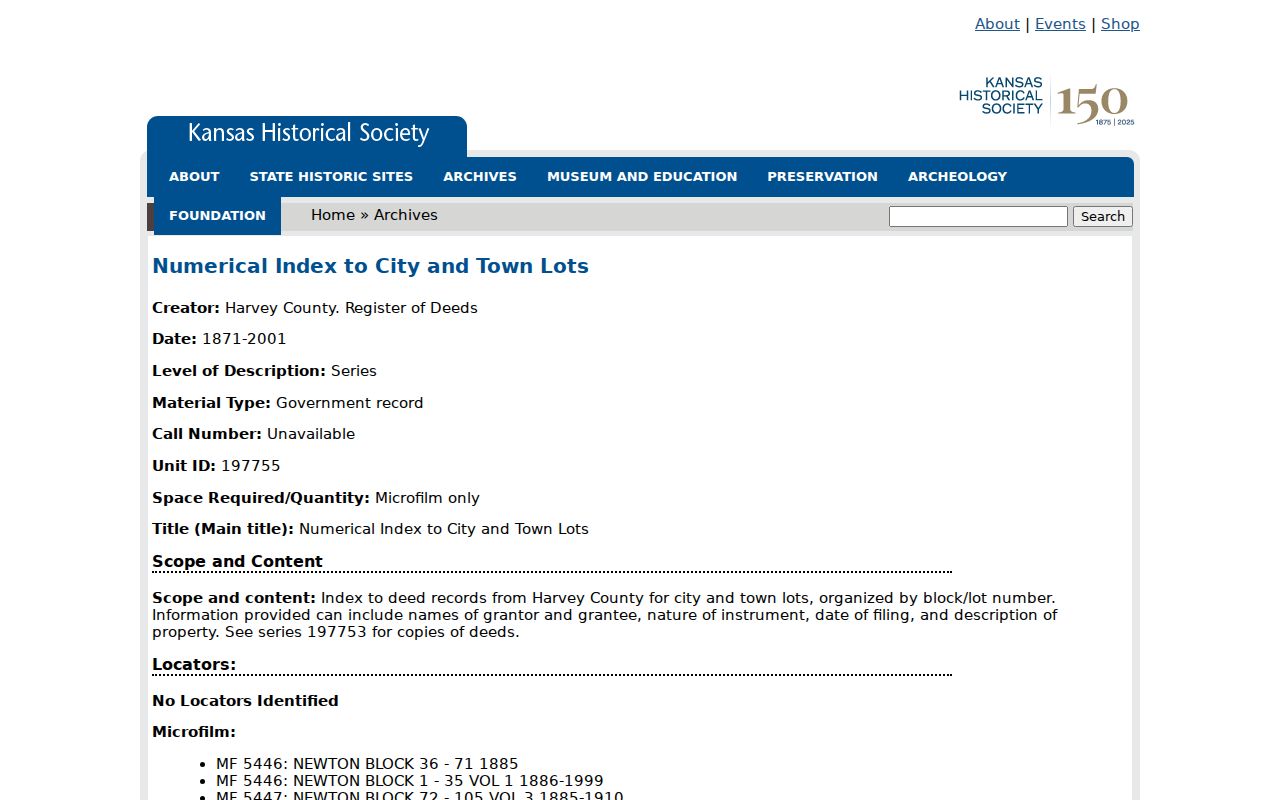
That index is a finding aid, not a deed itself. Newton lot records sit on MF5446 through MF5450, Halstead volumes 9 and 10 on MF5451, and Hesston volume 19 on MF5452. Pull the indexed deed before calling anyone a prior owner.
Walk the Harvey County Deed Chain Backward
The method simply runs time in reverse while holding the land still and letting the names change.
- Obtain the newest deed and copy its grantee, grantor, date, deed type, legal description, and record key.
- Treat that grantor as a former-owner candidate and search the name as an earlier grantee.
- Match the earlier deed by legal description, not merely surname or street.
- Repeat through office indexes, then shift to film and deed books where needed.
- Grantor and grantee
- The conveying and receiving parties.
- Chain of title
- The ordered instruments affecting the same land.
- Reverse index
- A route through grantor or grantee names.
- Quitclaim and warranty
- Different deed forms whose labels alone do not clear title.
Keep Harvey County Land Descriptions Fixed
An address finds a candidate property. Lot-and-block, subdivision, section-township-range, or metes-and-bounds language is what actually follows land through time. Splits, replats, annexations, and consolidations can each replace a parcel number. Recorded plats show how older and current descriptions relate to one another.
The county's subdivision procedure requires a final plat to be recorded within one year of approval. Otherwise, approval may be withdrawn. Building permits are barred before that final recording. This sequence explains why planning approval dates and deed recording dates sometimes differ from one another.
Note: Match each former owner to both an instrument and the land description before adding the name.
Estates and Corrections Bend Harvey County Chains
Executor deeds, court orders, affidavits, trust transfers, corrected deeds, and replats can all change a clean sale-to-sale line. These instruments shift ownership outside a normal sale. Kansas CaseSearch may surface the probate case. The Register of Deeds holds the actual land-transfer instrument. Mortgages, releases, liens, and lis pendens explain events but never transfer ownership on their own.
Search maiden and married names, initials, estate captions, trust names, and entity forms. Then circle back to the legal description. When a deed was corrected, read both versions before trusting either.
Test Harvey County History With Local Archives
The Newton Public Library genealogy collection holds directories and newspapers. It also offers census sources, obituaries, HeritageQuest, FamilySearch affiliate access, and reference help. The Harvey County Historical Museum keeps directories spanning 1885 through 1998. Together these sources can settle initials, address changes, and household timelines.
A directory occupant was not always an owner, though. Use directories and obituaries as cross-checks after the deed chain. They help most around relatives, estates, and rented homes.
Measure Harvey County Ownership Time Depth
KSHS catalogs county deed records from 1862 through 1927. City-lot indexing runs from 1871 through 2001. Tax rolls cover 1872 through 1909, 1916 through 1946, and 1953. Assessment rolls date from 1916 through 1953. These are separate series with gaps, not one merged database.
The Register of Deeds remains the source for current vault material. For copies, consult the Harvey County deed records guide. An archive trail is still not a title opinion.
Use Harvey County Previous Owners Lawfully
Former-owner research can back up house history, estate work, boundary study, and purchase diligence. Record the source dates. Keep confirmed transfers separate from mere clues.
Lawful use. Never use previous-owner information to stalk, harass, threaten, or target a living person.
When records stay unresolved, give the custodian a narrow request. Include the parcel, legal description, date range, names, and the exact record you need.
Follow Mortgages Without Mistaking Them for Harvey County Owners
The Register of Deeds also records mortgages, assignments, releases, federal and state tax liens, and lis pendens notices. These instruments explain why a transfer happened or why a parcel later landed in court. A name alone proves nothing. Match the debtor or borrower, legal description, dates, and any later release before drawing conclusions.
A lis pendens is notice that litigation may affect real estate. Its meaning comes from the related District Court case, not the notice itself. Kansas CaseSearch offers basic guest case information. A courthouse terminal may offer another public access route under Rule 22. Carry a case number back to the deed records only when an actual transfer followed.
Note: A mortgage, lien, or lawsuit can mark the chain's context without changing the owner of record in the deed sequence.
Compare Harvey County Tax Rolls With Deeds
KSHS holds real-estate assessment rolls covering 1916 to 1953. Its Harvey County tax records reach back further still. They open in 1872 and continue across several later periods. A tax roll pairs one taxpayer with one land description in one year. That helps when a deed index is hard to read. It also helps when a transfer date stays uncertain. Always confirm the taxpayer against the deed chain, though. Do that before treating the roll as proof of the owner of record. Compare one year with the next. When the taxpayer changes, the transfer fell within that interval. Search the deed index for those years under both name variants. If the land was split or replatted, trace the parent description before assuming a new parcel label means a new owner.
Preserve a Harvey County Former-Owner Research Log
Give every verified instrument its own row. Columns should cover recording date, execution date, grantor, grantee, deed type, book and page or instrument number, legal description, source, and notes. The two dates can differ. Recording both prevents a mis-sorted chain. Treat archive references as leads only until you view the deed itself. Copy names exactly as written. Add a normalized spelling in a separate note, cite the reel, volume, and page for every entry, and photograph or copy only what the Harvey County office permits so the finding can be checked again.
Resolve Name Changes in Harvey County Deed Books
Old indexes sort surnames differently than modern databases. An estate can appear under several forms. So can a business. Search initials, full names, maiden and married surnames, trustee wording, estate captions, and the exact entity name in the Harvey County deed books. Then apply a two-key rule. Reject any candidate whose legal description does not match the parcel you are tracing. Name plus land keeps a common surname from pulling an unrelated farm or town lot into your chain.
Street names can mislead an address search too. In Hesston, Shaver Avenue became Main Street in 1953, Emma Avenue became College Drive, Knott Street had been Nott, and Spangler closed. Log those changes as alternate address clues. They never prove the parcel itself stayed unchanged. Bridge the old street reference to the present parcel with the plat and the deed description.
When handwriting or film is unclear, cite the page as uncertain. Seek a second index or a tax-roll check, and never silently modernize a party name or legal description, because the original spelling may be the only path to the next deed.