
Fields Inside Harvey County Property Tax Records
Harvey County property tax records come from three offices. Knowing which desk holds what saves time. The Harvey County Appraiser keeps parcel descriptions and values. The Treasurer bills and collects the tax. The County Clerk prepares the real-estate and tax rolls and figures the levies. Read any result as a dated administrative record. It is not a sale appraisal or proof of title.
| Tax field | What the field answers | Official keeper or route |
|---|---|---|
| Parcel, CAMA, or tax ID | Which tax account is being viewed | Appraiser and Treasurer module |
| Owner or taxpayer name | Which name is tied to the selected role | Current county roll |
| Tax year | Which annual charge or status applies | Treasurer |
| Current or delinquent status | Whether the search is limited to current tax or statements with tax due | Treasurer module |
| Appraised and assessed figures | The valuation base and taxable classification, when available | Appraiser |
| Taxing unit and levy | The local unit and rates used for the bill | County Clerk and Treasurer |
The portal publishes no sample result, so exact payment, balance, exemption, and value labels stay open. Ask the responsible office directly. Give staff the parcel key and tax year, and they can supply the missing field.
Search Harvey County Tax Accounts in the CIC Module
The official Harvey County Tax Information Module goes well beyond a single address box. It separates real estate from personal property and several other tax classes. Search options include segmented CAMA data. You can also search by tax identification, owner or taxpayer name, street, subdivision, section-township-range, lease, and Quick Ref. Use only fields you can verify. Then save the database date along with the result.
| Search control | Accepted format or choice | Best use |
|---|---|---|
| Tax type | Real Estate, Personal Property, Oil, Gas, Trucks, Minerals, or State Assessed Utilities | Keep a land search in the correct class |
| CAMA segments | MAP, SEC, SHT, QTR, BLK, PRE, SUF, OWN | Recreate a known local account key |
| Tax year | Starting and ending year | Focus a multi-year check |
| Name and role | Owner or taxpayer name; Current Owner, Taxpayer, or Both | Distinguish how a name is used |
| Street | Street Number and Street Name | Start from a situs address |
| Subdivision or rural key | Subdivision, Block, Lot, or Section, Township, Range | Search from a legal-description clue |
| Status filter | Current taxes or statements with taxes due | Narrow current and delinquent results |
Two cautions apply to the form itself. Street Direction and ZIP appear only as hidden, nonfunctional placeholders. Treat them as unusable rather than public search controls. The named subdivision list can change as well. Confirm its spelling in the live selector before you commit to it.
The official tax search screen gives the public entry point. Use it for Harvey County property tax records.
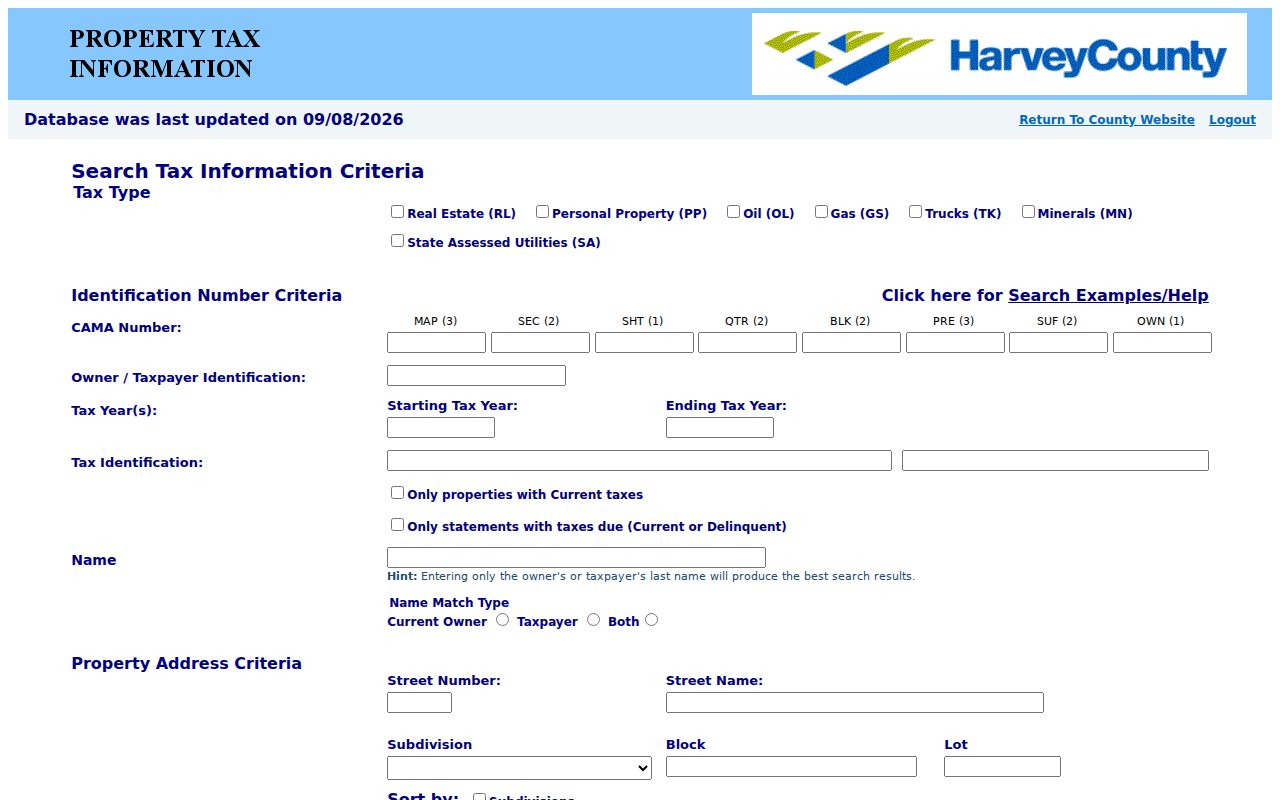
The image serves as a navigation aid, not a sample account. Confirm the live database date and search controls before relying on any result.
Note: Selectable years do not prove the earliest year of online Harvey County property tax coverage.
Trace a Harvey County Tax Bill From Address to Status
Preserve the key you used at every step of the lookup. A physical address works when that is all you know. Move to the parcel or CAMA key, though, before comparing tax years. Status filters can exclude useful records. Begin broadly and narrow only after the first result appears.
- Select Real Estate in the Tax Information Module and enter the street number and street name, owner name, parcel, or known CAMA parts.
- Choose the owner role deliberately. “Current Owner,” “Taxpayer,” and “Both” can return different name relationships.
- Set starting and ending tax years only when the inquiry is tied to a specific period.
- Repeat by parcel key if the address produces several matches, then ask the Treasurer to verify balance, receipt, or delinquency details.
- Compare valuation or classification questions with the Appraiser record rather than treating the tax statement as the only source.
- Assessed value
- The value produced after the constitutional classification percentage is applied to the appraised value.
- Mill levy
- A rate used with assessed value to calculate tax for the applicable taxing jurisdictions.
- Homestead or SAFESR
- State relief programs routed through the County Clerk; eligibility details belong with that office.
- Tax lien
- A claim for unpaid tax that may require Treasurer, court, and recorded-document checks.
Harvey County Splits Value, Levy, and Collection
One tax question can cross several desks in Harvey County. The Appraiser reviews and maintains values under Kansas law and Property Valuation Division guidance. The Clerk prepares the rolls and figures the levies. The Treasurer handles billing and collection. Have a value challenge? Point it at the Appraiser. A levy-record question goes to the Clerk. A payment or balance question belongs with the Treasurer.
The Appraiser sits at 215 S Pine Street in Newton, reachable at 316-284-6820. The Treasurer's county contact is at 800 N Main Street, with tax-office service through 316-284-6980. You can request an existing record under the Kansas Open Records Act. Name the parcel, year, and exact document. Do not ask an office to build a new report.
Kansas Classification Changes Harvey County Assessed Value
Appraised value and assessed value are not interchangeable in Harvey County. Kansas Constitution Article 11 assigns different assessment percentages by property class. Residential and multifamily real property use 11.5 percent. Agricultural land uses 30 percent. Vacant lots and nonprofit property each use 12 percent, while public utilities use 33 percent. Commercial and industrial property and agricultural improvements use 25 percent. Other urban or rural property uses 30 percent, subject to constitutional exemptions.
That classification step explains why a full-value estimate and the number used for taxation differ. It also explains something else. Two parcels with similar apparent sale values can carry different assessed amounts. The legal class, not the market figure alone, drives the tax roll.
Read the class first. An assessed value is a tax calculation input, not a prediction of the price a buyer would pay.
A Local Mill-Levy Example Needs Verification
Hesston's official property-tax page offers a useful local illustration. It applies the 11.5 percent residential assessment percentage to a $200,000 example. That produces $23,000 assessed before any levy. Its table then separates city, library, school, recreation, county, and state components. That breakdown makes the page helpful for understanding levy geography anywhere in Harvey County.
The same page carries a Newton total discrepancy. Its table displays 180.045 while the formula text uses 178.045. Keep track of which number came from which part of the source. Ask the Treasurer to confirm the applicable levy. Silently correcting the arithmetic would hide the conflict.
Note: A city example illustrates the formula but does not establish the levy for every Harvey County tax unit.
Registered Sale Data Is Separate From the Tax Bill
The Harvey County Real Estate page sends the public to the CIC parcel portal and notes that registered users may receive sale information under K.S.A. 79-1437f. The Appraiser can also provide additional cost information. That gate matters when a tax search does not expose the sale fact you expected. Deed records and sale data sit apart from the tax bill itself.
The county page shows the official bridge between real-estate records, appraisal contacts, the property search, and the annual calendar.
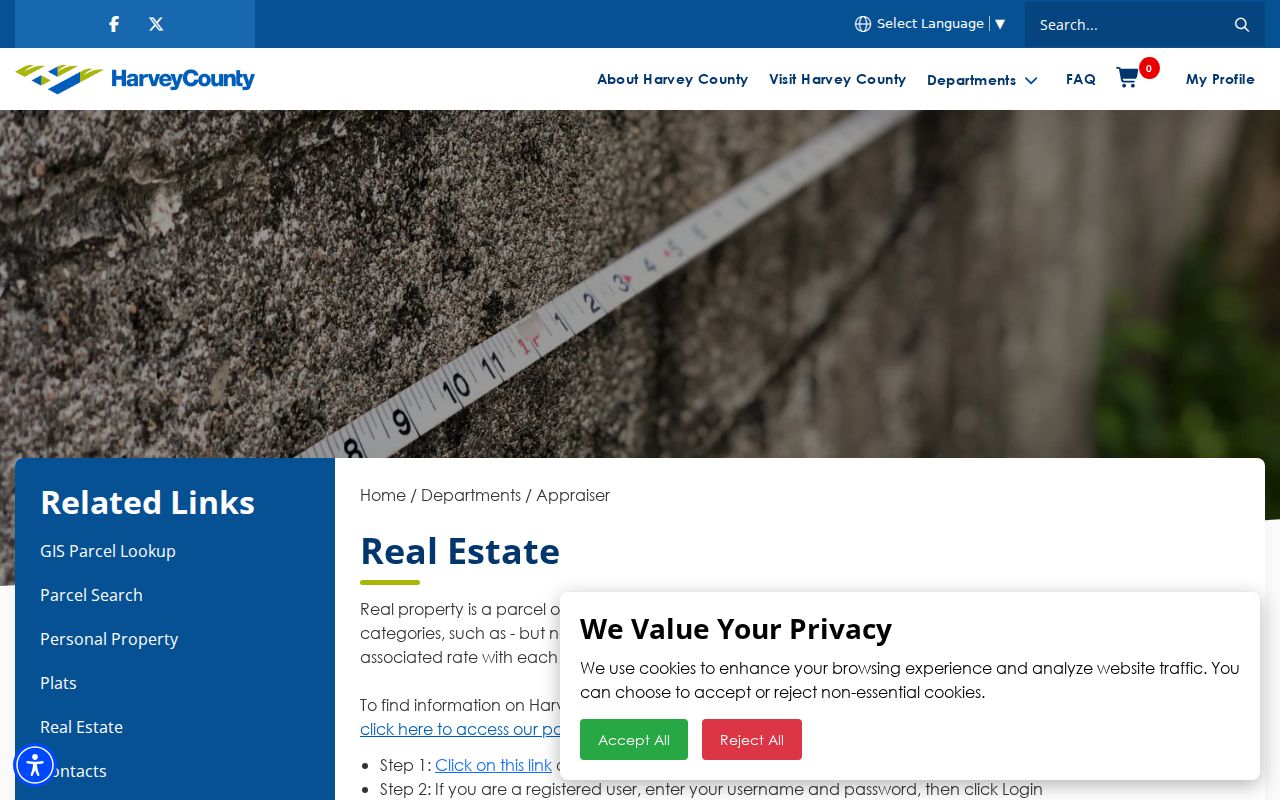
The screen confirms the county route. It does not establish that every sale, cost, or exemption field is public on a parcel card.
Read Harvey County Delinquency as a Record Sequence
A “taxes due” flag only opens the story. A distressed parcel leaves a much longer trail. To read the full sequence, follow the account through county notices, the District Court case, the sale confirmation, the sheriff’s deed, and any later Register of Deeds filing. Each step adds a document worth pulling. The official 2026 bidder packet covered a single sale, not a standing auction calendar or a searchable delinquent-property list. It set a January 22, 2026 sale date and spelled out payment and eligibility rules. Court confirmation came at about 30 days. The packet also listed a $38 deed filing fee, title caveats, and a 12-month set-aside limitation under K.S.A. 79-2804b, except for inadequate service issues. If the tax trail reaches litigation or a deed, check Kansas CaseSearch.
Challenge a Harvey County Property Assessment on Time
Harvey County sets real deadlines for taxpayers. The Real Estate calendar puts value notices in the mail by March 1. Valuation appeals are due March 31. Informal hearings run through May 15. Personal-property renditions are due March 15. Oil and gas renditions get until April 15. The truck rendition is due March 1. Calendars change. Confirm the current notice and filing deadline with the Appraiser before acting.
Build the appeal around the record itself. Gather the parcel ID, tax year, classification, property characteristics, and any evidence of an error in county data or valuation. The Appraiser handles taxpayer appeals and Board of Tax Appeals proceedings. A bill-payment issue never substitutes for a valuation appeal.
Appeal window. The researched county calendar lists March 31 for real-estate valuation appeals; confirm the current year and filing route with the Harvey County Appraiser.